We Reviewed OpenAI Whisper API: Here’s What Developers Need to Know

Quick Summary
OpenAI’s Whisper API offers fast, accurate transcription but struggles with long, multi-speaker, or noisy recordings, requiring extra handling for real-world workflows.
Cleanvoice API complements Whisper by automating audio cleanup, filler removal, stutter suppression, multi-track editing, and transcription, delivering publish-ready, studio-quality content with minimal developer effort.
Wondering if Whisper API Can Handle Real-World Production Audio?
OpenAI’s Whisper API can transcribe nearly any audio in almost any language with impressive speed. But the reality for developers isn’t always that simple.
Upload a long podcast or a multi-speaker meeting, and suddenly you’re juggling file size limits, chunked uploads, retry logic, and messy transcripts. Whisper is powerful, but it often stops right where real-world audio workflows begin.
In this Cleanvoice article, we dive deep into the Whisper API. Explore its capabilities, limitations, and practical considerations, so you can check whether it’s truly the solution you need.
But first…
Why Listen to Us?
At Cleanvoice, we’ve helped 15,000+ podcasters and top brands streamline audio production, from removing filler words to enhancing sound quality.
With years of experience in AI-powered audio editing and integrations, we understand the challenges developers face. This expertise allows us to provide clear, practical insights into using and evaluating Whisper API for real-world transcription and audio workflows.
What is Whisper API?
The Whisper API is OpenAI’s commercial, cloud-based implementation of its open-source Whisper automatic speech recognition (ASR) model.
The original Whisper model was released in September 2022 and quickly became a standout in the NLP community. Trained on 680,000 hours of multilingual, multitask supervised audio data, it set a new benchmark for accurate transcription and speech-to-text translation across accents and noisy conditions.
Whisper runs on OpenAI's transformer-based encoder-decoder architecture, processing audio in 30-second chunks. Approximately one-third of its training data is non-English, giving the API robust handling of accents, technical jargon, and background noise.
While the open-source model was powerful, running it in production posed significant challenges. It required GPU infrastructure, careful optimization, and engineering effort to scale reliably. To address this, OpenAI launched the Whisper API in March 2023, exposing the large-v2 model as a managed, on-demand service.
Technical Overview of Whisper API
API Endpoints and Model Evolution
-
The Whisper API provides two primary endpoints:
- /transcriptions: Converts speech to text in the same language
- /translations: Converts speech to English text only
-
Model options include:
- whisper-1: Original API model.
- gpt-4o-transcribe: Higher-quality transcription.
- Gpt-4o-mini-transcribe: Cost-effective option.
- gpt-4o-transcribe-diarize: Adds speaker identification with optional reference audio.
Key Capabilities
- Speaker Diarization: The diarize model identifies different speakers and accepts reference audio clips to label known voices
- Precise Timestamps: Request segment or word-level timestamps for subtitle creation
- Contextual Prompts: Guide GPT-4o models with text prompts for term correction or context consistency
- Confidence Scores: Log probabilities reveal model certainty
- Language Support: Nearly 100 languages; Word Error Rate (WER) <50% for official languages.
API Specifications
The API accepts MP3, MP4, WAV, and WEBM formats with a 25 MB upload limit, requiring client-side chunking for longer files. Output formats include plain text, JSON, SRT, and VTT. OpenAI retains data for 30 days by default, though enterprises can opt out.
What We Think About OpenAI’s Whisper API
Performance and Speed
OpenAI’s Whisper API delivers impressive transcription performance, especially on clean audio, making it a highly capable ASR solution.
On noise-free recordings, Whisper Large-v3 can achieve a Word Error Rate (WER) as low as 2.7%, approaching human-level transcription accuracy.
However, performance is highly dependent on audio conditions: background noise, overlapping speakers, or poor recording quality can increase WER significantly. Recent studies of call center and emergency medical recordings show WER can reach up to 17.7% in noisy environments.
In benchmark comparisons, Whisper remains competitive but not always the leader.

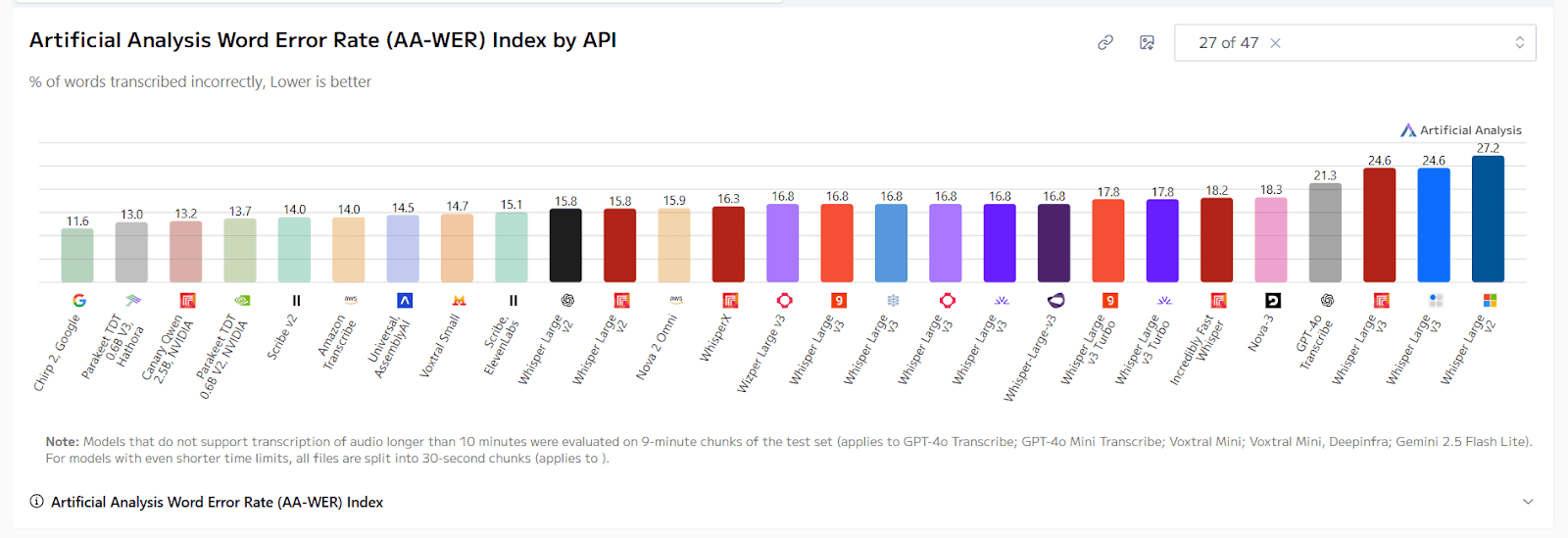
- Whisper Large v2: 15.8% WER
- Google Chirp 2: 11.6% WER (higher accuracy on standard benchmarks)
- AssemblyAI Universal: 14.5% WER
- GPT-4o Transcribe: 21.3% WER (trades raw accuracy for smoother transcripts)
Where Whisper truly stands out is speed and scalability. The Large-v3 Turbo variant achieves 216x real-time processing, transcribing a 60-minute file in roughly 17 seconds, making it one of the fastest production-ready transcription APIs available.
Integration
Simplified Development vs. Managed Constraints
From an integration standpoint, Whisper API’s biggest win is abstraction. You get production-grade speech recognition through a single HTTP request.
No GPU provisioning, no model lifecycle management, no scaling logic to babysit. For teams that want transcription working today, this is a clear advantage.
That simplicity comes with non-negotiable constraints. The most visible is the 25 MB upload limit.
Any serious long-form use case, such as podcasts, meetings, or lectures, requires client-side chunking before ingestion. In practice, this means building and maintaining audio-splitting logic, managing offsets, and later reassembling transcripts. It’s not difficult, but it’s unavoidable overhead.
In OpenAI’s broader ecosystem, Whisper now occupies a narrow, well-defined role: batch transcription. With the rise of multimodal and real-time audio APIs, Whisper is no longer positioned for conversational or low-latency voice workflows.
It fits best where audio is uploaded, processed asynchronously, and passed downstream.
Practical Implementation
The API structure is clean and predictable. Two endpoints (/transcriptions and /translations) cover most use cases, and official Python and Node.js SDKs remove boilerplate around authentication and file uploads.
Advanced features like speaker diarization or word-level timestamps are parameter-driven extensions, not separate workflows. That consistency makes incremental adoption straightforward.
However, a meaningful portion of “integration work” lives outside the API call:
- Pre-processing audio to improve accuracy
- Prompting GPT-4o transcription models with domain context
- Retrying failed chunks and validating partial outputs
Architectural Integration
In production, Whisper is almost always step one.
The dominant pattern is Whisper → LLM → downstream logic (summaries, analytics, search). That pipeline works, but it’s modular by necessity, not design.

For high-volume or compliance-heavy environments, that decision often leads to self-hosting Whisper, an entirely different operational commitment.
Cost
Core Pricing Model
At a glance, Whisper API pricing is simple.
The standard rate is $0.006 per minute of audio, billed by the second, with no minimum duration, usage tiers, or regional price differences. That predictability is a real advantage for teams forecasting costs or embedding transcription deeply into a product.
There’s no permanent free tier, but it’s worth noting that new OpenAI accounts receive $5 in free API credits, typically valid for three months. This is enough to run small proof-of-concept tests, though sustained evaluation and load testing will still incur costs quickly.
Total Cost Analysis
The base price covers transcription but not the surrounding production work.
Historically, speaker diarization was a major gap in Whisper-based systems, often requiring third-party services or open-source tooling. That has changed.
OpenAI now offers gpt-4o-transcribe-diarize, which includes speaker identification at the same $0.006/min rate, eliminating the need for an external diarization service in most cases.
That said, engineering overhead still dominates total cost of ownership. Production usage typically requires:
- Client-side chunking for long files (due to the 25 MB upload limit)
- Retry logic and ordering guarantees across chunks
- Throughput monitoring and failure handling
Even for modest systems, this can translate into several developer days, often exceeding $2,000 in one-time integration cost before launch.
When those costs are amortized, the effective per-minute rate of a usable transcription pipeline is higher than the headline number, especially at low to mid volumes.
Despite these realities, Whisper remains one of the most cost-effective managed transcription APIs on the market. Compared to major cloud providers, where speech-to-text commonly ranges from $1.00–$1.60 per hour, Whisper delivers roughly 70–75% lower raw transcription costs.
Self-Hosting Cost
Self-hosting Whisper can reduce marginal cost at scale, but the break-even point is high.
GPU infrastructure typically starts around $250–$300 per month, and once DevOps labor, monitoring, and redundancy are included, monthly costs often exceed $800–$1,000.
In practice, self-hosting only becomes economically compelling beyond 2,400 hours per month, or when regulatory, privacy, or deep customization requirements rule out third-party APIs.
Use Cases
Transcription & Translation
At its foundation, Whisper excels at batch transcription across common audio and video formats. It’s widely used to generate transcripts and subtitles for podcasts, videos, meetings, and lectures, unlocking searchability, accessibility, and reuse.
The ability to output SRT and VTT files makes it especially practical for media platforms focused on SEO and compliance.
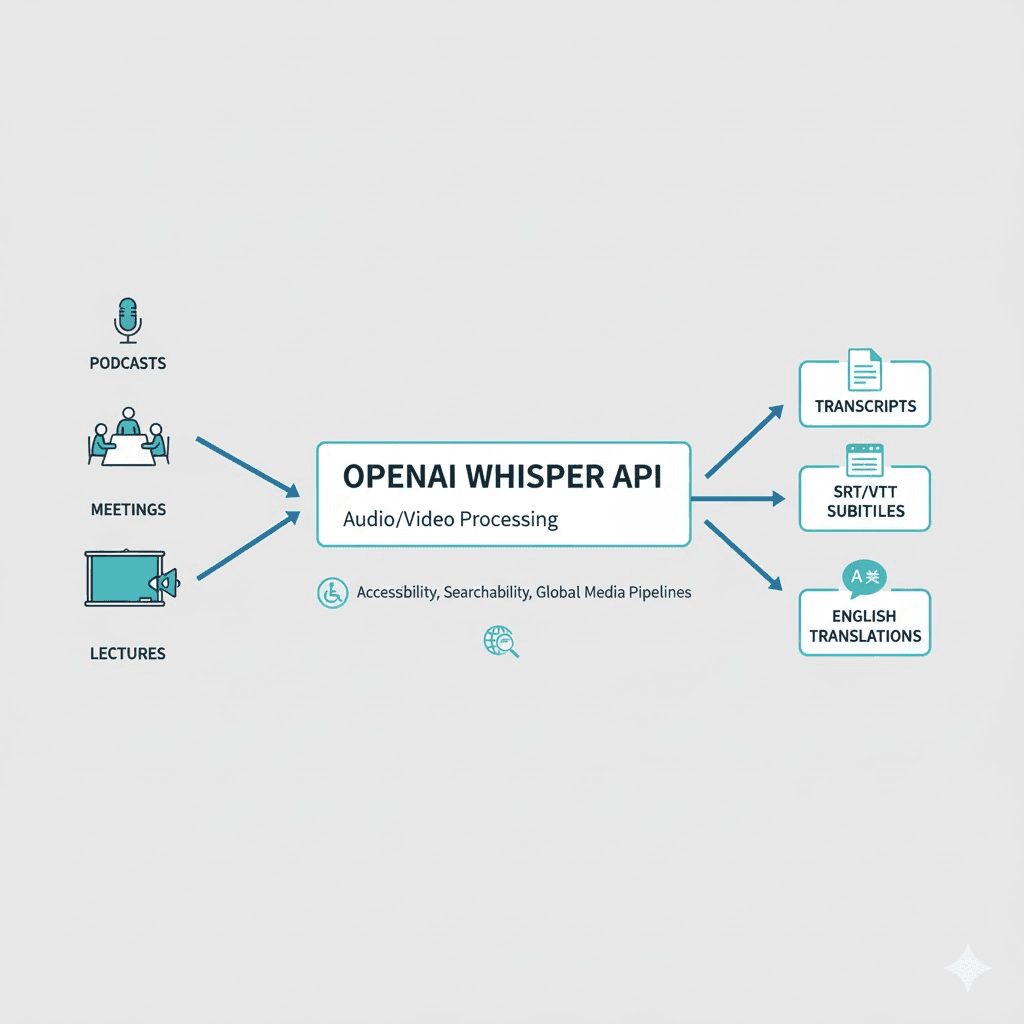
Its one-step speech-to-English translation is another standout. For teams processing multilingual content, Whisper removes the need for separate ASR and translation layers, simplifying pipelines for global media ingestion.
Product Features Built on Top
Many products use Whisper as the listening layer behind:
- Voice search and command interfaces
- Language learning apps that analyze pronunciation
- Accessibility tools that generate captions or readable text from speech
In these cases, Whisper’s role is not user-facing; it’s infrastructure.
Operational & Analytical Workflows
In business settings, Whisper often feeds transcripts into analytics systems.
- Customer support teams transcribe calls to extract sentiment, detect trends, or evaluate agent performance.
- Researchers and product teams use it to process interviews and qualitative feedback at scale.
- Healthcare and telemedicine platforms rely on it for documentation, often alongside secondary validation systems to improve accuracy.
Introducing Cleanvoice API: An Easier, More Comprehensive Way to Edit and Transcribe Audio
Whisper transcribes audio well. But once you have a transcript, the real work starts: cleaning up filler words, removing background noise, enhancing audio quality, merging multi-track files, and generating summaries or social content.
That's usually four or five separate tools. Cleanvoice handles all of it in a single API call.

Submit your file, configure what you need, and get back clean, publish-ready audio along with transcripts, chapters, summaries, and social-ready highlights, without building or maintaining extra pipelines.
Getting started is straightforward.
Once you sign up, switch to Developer mode from your profile, follow the step-by-step onboarding, and copy-paste your first request directly from the dashboard. You can run a live test without leaving the setup flow.
Technical Overview of the Cleanvoice API
Primary Endpoints
- /uploads -
-
Upload a local file and get back a signed URL to use in your edit request Or upload via a public URL.
-
Submit single or multi-track files.
-
Apply cleanup: filler words, stutters, mouth sounds, dead-air, background noise, and studio-quality enhancement.
-
Optional transcription, summarization, and social content optimization.
-
Export in MP3, WAV, FLAC, M4A, or automatic format.
- /edit -
- Create an edit job.
- Submit single or multi-track files with your chosen configuration: filler words, stutters, mouth sounds, dead-air, background noise removal, studio-quality enhancement, transcription, summarization, and social content.
- Export in MP3, WAV, FLAC, M4A, or auto format.
- /edit/<id> -
- Retrieve results
- Track progress (PENDING, STARTED, SUCCESS, FAILURE).
- Download edited audio and access statistics and structured outputs: transcripts, chapters, and social-ready snippets.
- /edits/<id> DELETE -
- Remove files before the default 7-day retention.
Key Capabilities
- Filler word, stutter, mouth sound, and dead-air removal
- Background noise removal and Studio Sound 3.0 audio enhancement
- Multi-track editing and merging
- Transcription and summarization in multiple languages
- Social content generation for highlights and captions
Pricing

- Pay-As-You-Go: Credits cost $2.20–$1.50 per hour depending on volume, valid for 2 years.
- Subscription Plans: Per-hour rates ($1.10–$0.90/hour) with credits rolling over up to 3× the plan limit.
- Custom Enterprise Options: For high-volume users (200+ hours/month) or special API needs
For full details, see our pricing page.
Why Teams Rely on Cleanvoice API for Production-Ready Audio
End-to-End Audio Production in One API
Unlike standard ASR tools that only transcribe, Cleanvoice handles the full post-production workflow: noise reduction, filler removal, stutter suppression, multi-track merging, and structured content creation. This reduces the need for multiple services, libraries, or custom processing pipelines.

Asynchronous, Scalable, and Reliable
Cleanvoice is designed for high-volume processing with predictable asynchronous workflows. Developers can submit files via a single API call, track job progress, and retrieve results programmatically, eliminating the need for complex queuing or retry logic.
Multi-Track & Studio-Level Enhancements
Whether it’s a podcast, interview, or multi-speaker meeting, Cleanvoice allows multi-track uploads, automated merging, and “Studio Sound” processing for professional-grade audio. This removes the overhead of separate audio engineering tools or manual editing.
Integrated Transcription & Structured Outputs
Beyond cleaning audio, Cleanvoice delivers actionable data: full transcripts, paragraph-level timing, chapters, summaries, and social media-ready highlights. Developers can build analytics, search, or content pipelines directly from the API outputs without extra post-processing.
Flexible Developer-Friendly Integrations
With official Python and Node.js SDKs, support for public or signed URLs, and workflow integrations like n8n and Make.com, Cleanvoice fits seamlessly into modern development pipelines. Its RESTful design and JSON outputs make it easy to plug into existing services or serverless architectures.
Streamline Audio Editing and Transcription Using Cleanvoice API
Transcribing and cleaning up audio can be time-consuming, frustrating, and prone to errors, especially when relying solely on basic ASR tools like Whisper API. Developers often face challenges with noisy recordings, speaker overlaps, or managing multiple post-production steps manually.
Cleanvoice API solves these pain points by combining transcription, filler removal, stutter suppression, mouth sound muting, and studio-level audio enhancement into a single, easy-to-integrate pipeline. Multi-track support, structured outputs, and social-ready snippets mean you can turn raw recordings into polished content faster and with less engineering overhead.
Ready to simplify your workflow? Get started with Cleanvoice API today.