Auphonic alternative
Auphonic alternative with fewer word errors
Cleanvoice Studio Sound 4.1 is an AI audio enhancer you can use instead of Auphonic Studio Voice, Auphonic's speech enhancement model. On 100 noisy clips from Dolby's public UNIVERSE set, it made fewer word errors (15.5% vs 20.3%), scored higher on speech quality (SCOREQ 4.54 vs 4.16) and restored more bandwidth (17.3 vs 16.5 kHz). It also dropped fewer words: 3.0 per 100, against 6.2.
Last updated: 2 November 2026 · 100 clips from Dolby’s public UNIVERSE set · Full benchmark
Word error rate (lower is better)
15.5%
Cleanvoice, vs 20.3% for Auphonic
Dropped words (lower is better)
3.0%
Cleanvoice, vs 6.2% for Auphonic
Speech quality (SCOREQ) (higher is better)
4.54
Cleanvoice, vs 4.16 for Auphonic
Head to head on every metric
Auphonic Studio Voice against Cleanvoice Studio Sound 4.1, with the unprocessed input for context. Same 100 clips, run on 1 November 2026: Cleanvoice processed each clip separately; the other tools processed the 100 clips joined into one file. Method and all eight tools.
| Metric | Unprocessed input | Auphonic | Cleanvoice Studio Sound 4.1 | Better |
|---|---|---|---|---|
| Word error rate ↓Omnilingual ASR on the output vs on the clean original | 17.0% | 20.3% | 15.5% | Cleanvoice |
| Dropped words ↓Deletions per 100 reference words | 5.9% | 6.2% | 3.0% | Cleanvoice |
| Changed words ↓Substitutions per 100 reference words | 10.8% | 13.8% | 11.2% | Cleanvoice |
| Speech quality (SCOREQ) ↑Natural speech quality, 1 to 5 | 2.64 | 4.16 | 4.54 | Cleanvoice |
| Overall quality (DNSMOS OVRL) ↑DNSMOS P.835 overall score, 1 to 5 | 2.27 | 3.21 | 3.35 | Cleanvoice |
| Speaker similarity ↑How close the voice stays to the clean original | 0.916 | 0.949 | 0.955 | Cleanvoice |
| Intelligibility (ESTOI) ↑Against the clean reference | 0.714 | 0.793 | 0.840 | Cleanvoice |
| PESQ ↑Against the clean reference | 1.55 | 1.60 | 1.88 | Cleanvoice |
| Bandwidth ↑Median output bandwidth; the input stops at 8 kHz | 8.0 kHz | 16.5 kHz | 17.3 kHz | Cleanvoice |
Cleanvoice has the better number on every metric. The biggest gaps are word errors, dropped words and speech quality.
↓ lower is better, ↑ higher is better. Dropped and changed words are per 100 reference words. Word error rate also counts words the transcriber added, so those two don’t add up to it.
Clip by clip
Of the 100 clips, Cleanvoice had fewer word errors than Auphonic on 41, the same number on 45 and more on 14.
- 41Cleanvoice betterfewer word errors
- 45Sameequal word errors
- 14Auphonic betterCleanvoice had more word errors
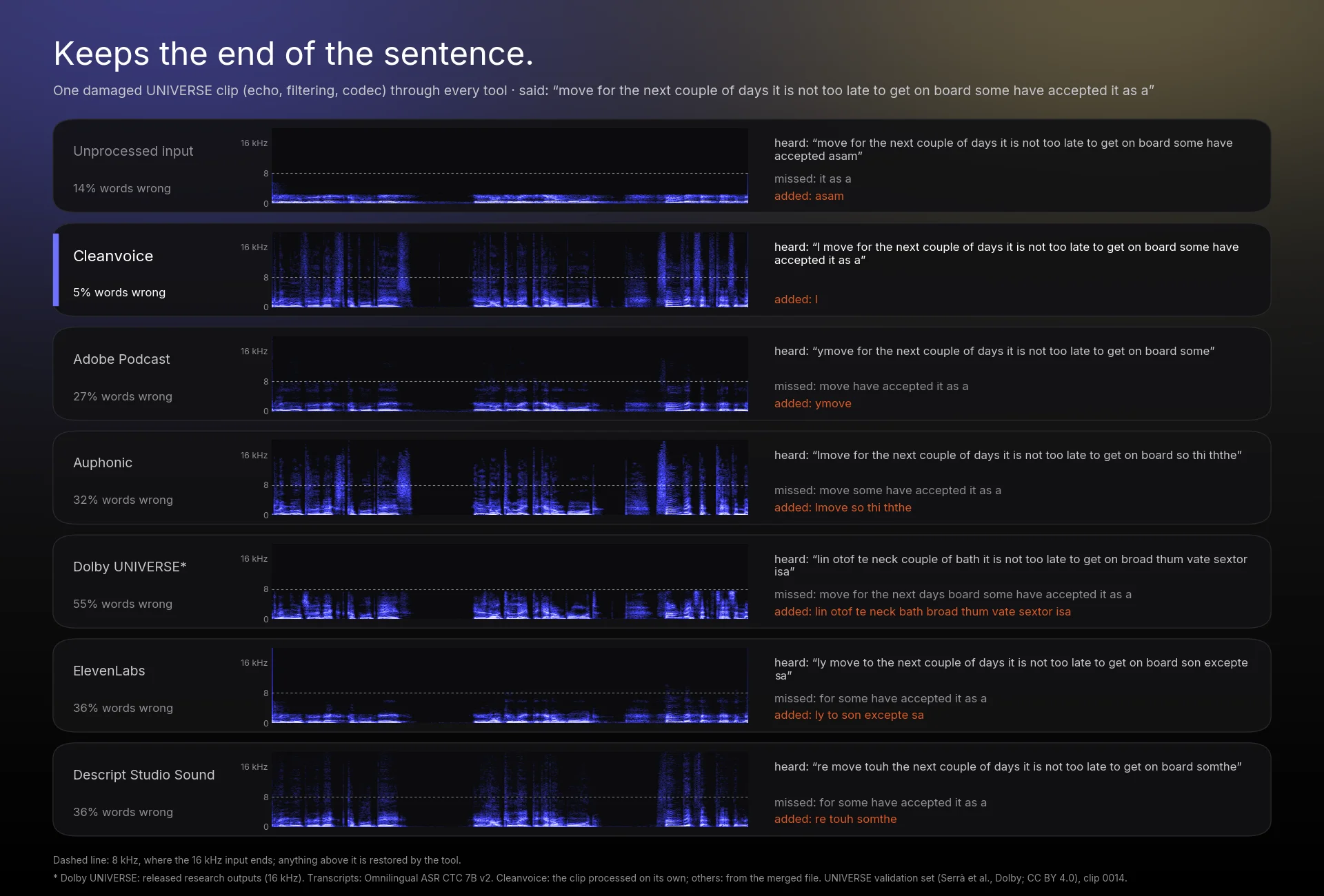
Listen: clip 0014
A damaged clip: echo, a band-reject filter and AC-3 codec damage. The speaker says: “move for the next couple of days it is not too late to get on board some have accepted it as a”. Listen for the end of the sentence, “some have accepted it as a”.
Clip 0014
Selected: Original (unprocessed)
Auphonic alternatives, ranked
Every tool in our benchmark, fewest word errors first. Same 100 clips, run on 1 November 2026. Cleanvoice and DeepFilterNet3 processed each clip on its own; the other products processed the 100 clips joined into one file. See all metrics.
| # | Tool | Word error rate ↓ | Dropped words ↓ | Speech quality (SCOREQ) ↑ | Bandwidth ↑ | Note |
|---|---|---|---|---|---|---|
| 1 | Cleanvoice Studio Sound 4.1 | 15.5% | 3.0% | 4.54 | 17.3 kHz | Fewest word errors and dropped words; best SCOREQ, DNSMOS and speaker similarity; 17.3 kHz bandwidth, tied with Descript for the widest. |
| 2 | Cleanvoice Studio Sound 4.0 | 16.7% | 3.2% | 4.51 | 14.0 kHz | Our previous model. 8% more word errors than 4.1, and 14.0 kHz bandwidth. |
| 3 | Adobe Podcast Enhance Speech | 17.1% | 6.8% | 3.57 | 9.5 kHz | Fewest word errors of the other companies (17.1%), close to the unprocessed input (17.0%). Fewest changed words and best PESQ of the products; 9.5 kHz bandwidth. |
| 4 | Auphonic Studio Voice | 20.3% | 6.2% | 4.16 | 16.5 kHz | Best speech quality of the other products; 16.5 kHz bandwidth. |
| 5 | Dolby UNIVERSE (research outputs) | 22.3% | 5.1% | 4.33 | 8.0 kHz | Research outputs from the paper, not a product you can use. Best ESTOI and PESQ. |
| 6 | DeepFilterNet3 | 22.6% | 9.6% | 3.18 | 7.5 kHz | Open-source noise remover. Most dropped words (9.6 per 100) and lowest speech quality; no added bandwidth. |
| 7 | ElevenLabs Voice Isolator | 23.8% | 7.1% | 3.72 | 11.8 kHz | Lowest speaker similarity; 7.1 dropped words per 100. |
| 8 | Descript Studio Sound | 25.4% | 8.1% | 3.99 | 17.3 kHz | Most word errors and changed words; 17.3 kHz bandwidth, tied with Cleanvoice for the widest. |
| – | Unprocessed input | 17.0% | 5.9% | 2.64 | 8.0 kHz | The noisy file every tool received, for context. |
The unprocessed input scored 17.0%. Cleanvoice (15.5%) was the only tool clearly below it; Adobe Podcast (17.1%) was about level with it, and the other four tools made more word errors than the input.
Which one to choose
When to choose Auphonic
- You want one tool for the whole post-production chain. Auphonic is a full post-production tool, with levelling and loudness targets as well as noise reduction. This page only compares Studio Voice with Studio Sound.
When to choose Cleanvoice
- You want higher quality scores. Cleanvoice scored higher on speech quality (SCOREQ 4.54 vs 4.16) and overall quality (DNSMOS 3.35 vs 3.21), and restored 17.3 kHz of bandwidth against 16.5 kHz.
- You want fewer dropped words. Cleanvoice dropped 3.0 words per 100, against 6.2 for Auphonic and 5.9 in the unprocessed input.
- You want enhancement that only works on the sound. Cleanvoice Studio Sound removes background noise, echo and other voices and restores bandwidth. It has no step that cuts or rewrites words.
- You may also want editing later. Filler-word, stutter and silence removal are separate, optional Cleanvoice edits. You choose whether to use them, and Studio Sound works without them.
- You want the same model in the web app and the API, so a manual workflow can become an automated one without changing the sound.
More on what it fixes: Cleanvoice Studio Sound, the AI audio enhancer.
How we tested
- Data: the 100 noisy clips of Dolby’s public UNIVERSE validation set (Serrà et al., CC BY 4.0; noises include DEMAND, CC BY-SA).
- Processing: each tool’s own product or API on 1 November 2026, at default enhancement settings. Cleanvoice processed each clip separately; the other tools processed the 100 clips joined into one 8.4-minute, 16 kHz file, which we cut back into clips. Dolby UNIVERSE is the paper’s released research outputs.
- Word metrics: Meta’s Omnilingual ASR (CTC 7B v2) transcripts of each output against the same model on the clean originals (1,423 words). CTC models generally don’t hallucinate the way models with a language model do. Word error rate also counts words the transcriber added, so dropped and changed words don’t add up to it.
- Quality: SCOREQ and DNSMOS P.835 OVRL. Speaker similarity, ESTOI and PESQ are measured against the clean original.
- Limits: one dataset, 100 clips, 16 kHz input only, an automatic transcriber, and a test run by Cleanvoice itself.
The full method, every tool’s numbers and more audio are on the speech enhancement benchmark page.
Auphonic comparison questions
More comparisons and the full benchmark
- Speech enhancement benchmarkAll eight tools on 100 noisy clips: every metric, the method and the audio.
- Cleanvoice Studio Sound, the AI audio enhancerBackground noise removal, voice isolation, de-reverb and bandwidth extension in one pass.
- Cleanvoice vs AuphonicEvery metric, head to head.
- Adobe Podcast Enhance Speech alternativeFor creators leaving Adobe Podcast, with the ranked table.
- Cleanvoice vs Adobe PodcastEvery metric, head to head.
- Cleanvoice vs ElevenLabs Voice IsolatorEvery metric, head to head.
- Cleanvoice Studio Sound vs Descript Studio SoundEvery metric, head to head.
Adobe, Auphonic, Descript, ElevenLabs and Dolby are trademarks of their owners. Tests run by Cleanvoice on 1 November 2026; results may differ on other material.




Hear it on your own audio.
Upload a noisy recording and get it back enhanced. New accounts get 30 free minutes, no credit card needed.