




AI speech enhancer benchmark 2026
We ran 100 noisy recordings through eight speech enhancers and counted the word errors.
- Model under test
- Cleanvoice Studio Sound 4.1
- Evaluation
- Cleanvoice AI Research
- Dataset
- Dolby UNIVERSE, 100 clips
- Other tools
- Their own app or API, default settings
- Snapshot
- 2 November 2026
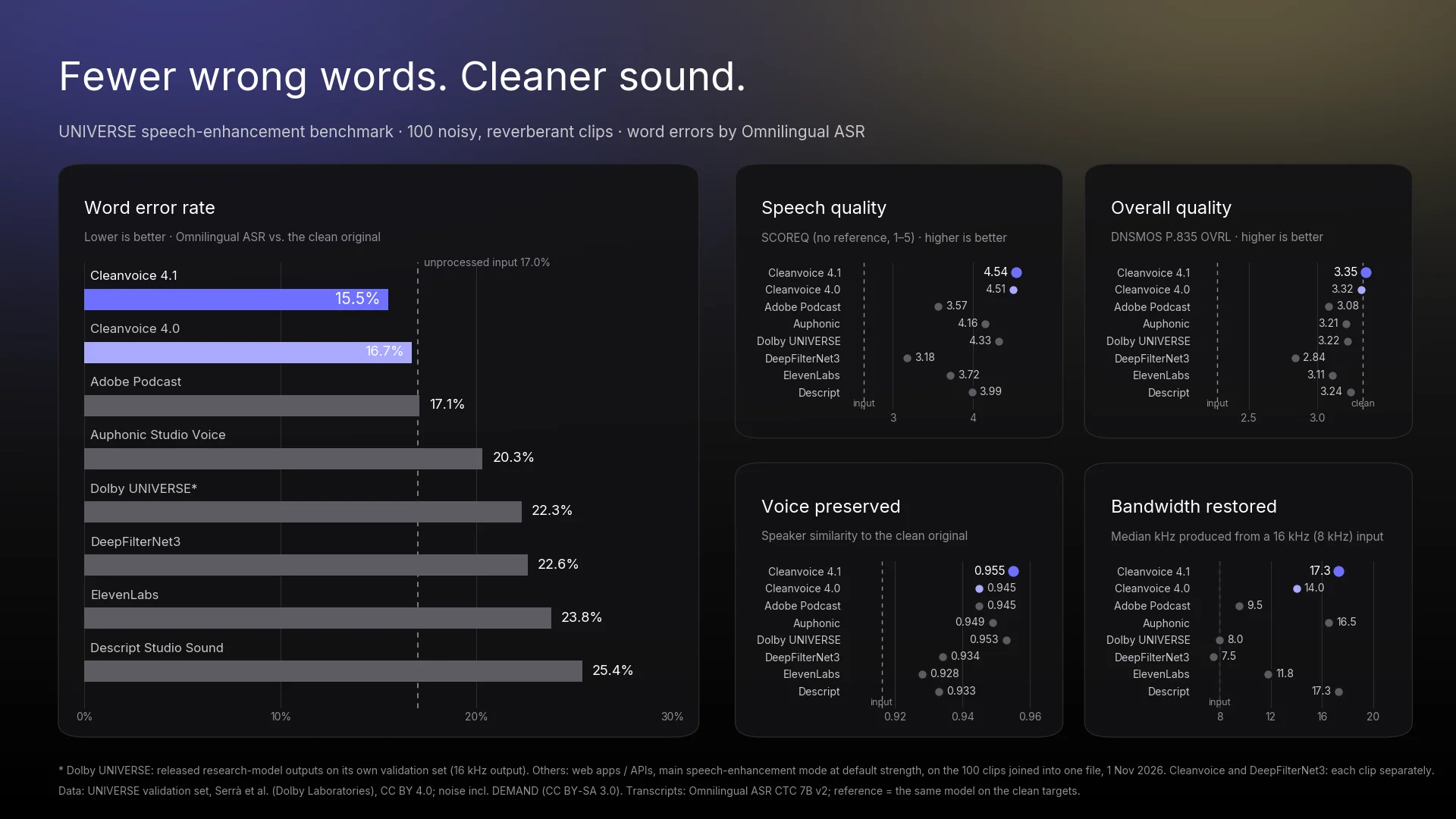
Cleanvoice Studio Sound 4.1 made the fewest word errors: 15.5%, against an average of 21.8% for Adobe Podcast, Auphonic, Dolby UNIVERSE, ElevenLabs and Descript. It dropped 56% fewer words than that average, and got the top SCOREQ, DNSMOS and speaker similarity scores.
At a glance
- Word error rate15.5%1st of 8next best: Adobe Podcast 17.1%
- Dropped words3.0%1st of 8next best: Dolby UNIVERSE 5.1%
- SCOREQ4.541st of 8next best: Dolby UNIVERSE 4.33
- DNSMOS OVRL3.351st of 8next best: Descript 3.24
- Speaker similarity0.9551st of 8next best: Dolby UNIVERSE 0.953
01Overview
Each cell is coloured by the tool's place in that column; solid blue is first. Lower is better for the word columns. Higher is better for the rest.
| Tool | Word error rate (lower is better) | Dropped words (lower is better) | Changed words (lower is better) | SCOREQ (higher is better) | DNSMOS OVRL (higher is better) | Speaker similarity (higher is better) | ESTOI (higher is better) | PESQ (higher is better) | Bandwidth (higher is better) |
|---|---|---|---|---|---|---|---|---|---|
| Cleanvoice Studio Sound 4.1 | 15.5% (best) | 3.0% (best) | 11.2% | 4.54 (best) | 3.35 (best) | 0.955 (best) | 0.840 | 1.88 | 17.3 kHz (best) |
| Cleanvoice Studio Sound 4.0 | 16.7% | 3.2% | 12.4% | 4.51 | 3.32 | 0.945 | 0.832 | 1.94 | 14.0 kHz |
| Adobe Podcast (Enhance Speech) | 17.1% | 6.8% | 9.8% (best) | 3.57 | 3.08 | 0.945 | 0.824 | 2.07 | 9.5 kHz |
| Auphonic Studio Voice | 20.3% | 6.2% | 13.8% | 4.16 | 3.21 | 0.949 | 0.793 | 1.60 | 16.5 kHz |
| Dolby UNIVERSE (research outputs) | 22.3% | 5.1% | 15.7% | 4.33 | 3.22 | 0.953 | 0.863 (best) | 2.64 (best) | 8.0 kHz |
| DeepFilterNet3 (open source) | 22.6% | 9.6% | 12.4% | 3.18 | 2.84 | 0.934 | 0.753 | 1.85 | 7.5 kHz |
| ElevenLabs Voice Isolator | 23.8% | 7.1% | 15.3% | 3.72 | 3.11 | 0.928 | 0.754 | 1.78 | 11.8 kHz |
| Descript Studio Sound | 25.4% | 8.1% | 16.1% | 3.99 | 3.24 | 0.933 | 0.803 | 1.85 | 17.3 kHz (best) |
| Unprocessed input | 17.0% | 5.9% | 10.8% | 2.64 | 2.27 | 0.916 | 0.714 | 1.55 | 8.0 kHz |
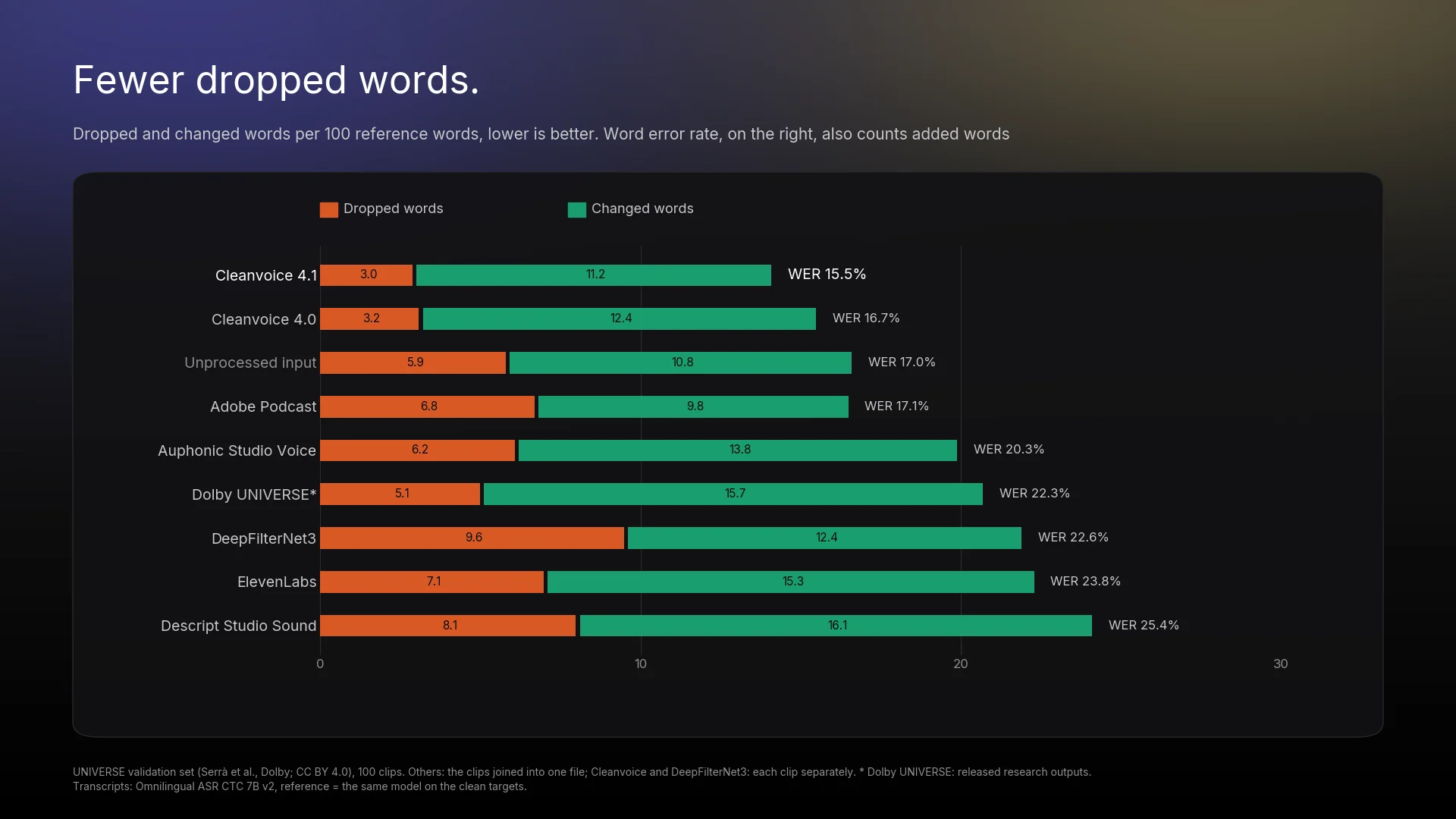
The raw input is there for reference and isn't ranked. DeepFilterNet3 is a free open-source model. Dropped and changed words are per 100 words. Word error rate also counts words the transcriber added, so those two don't add up to it. Cleanvoice 4.1, 4.0 and DeepFilterNet3 processed each clip on its own; the other tools processed all 100 clips joined into one file.
02Word errors
A speech enhancer should clean the sound and leave the words alone. Here are the two main kinds of error: words dropped and words changed.
| Tool | Word error rate (lower is better) | Dropped words (lower is better) | Changed words (lower is better) |
|---|---|---|---|
| Cleanvoice Studio Sound 4.1 | 15.5% (best) | 3.0% (best) | 11.2% |
| Cleanvoice Studio Sound 4.0 | 16.7% | 3.2% | 12.4% |
| Adobe Podcast (Enhance Speech) | 17.1% | 6.8% | 9.8% (best) |
| Auphonic Studio Voice | 20.3% | 6.2% | 13.8% |
| Dolby UNIVERSE (research outputs) | 22.3% | 5.1% | 15.7% |
| DeepFilterNet3 (open source) | 22.6% | 9.6% | 12.4% |
| ElevenLabs Voice Isolator | 23.8% | 7.1% | 15.3% |
| Descript Studio Sound | 25.4% | 8.1% | 16.1% |
| Unprocessed input | 17.0% | 5.9% | 10.8% |
03Clip by clip
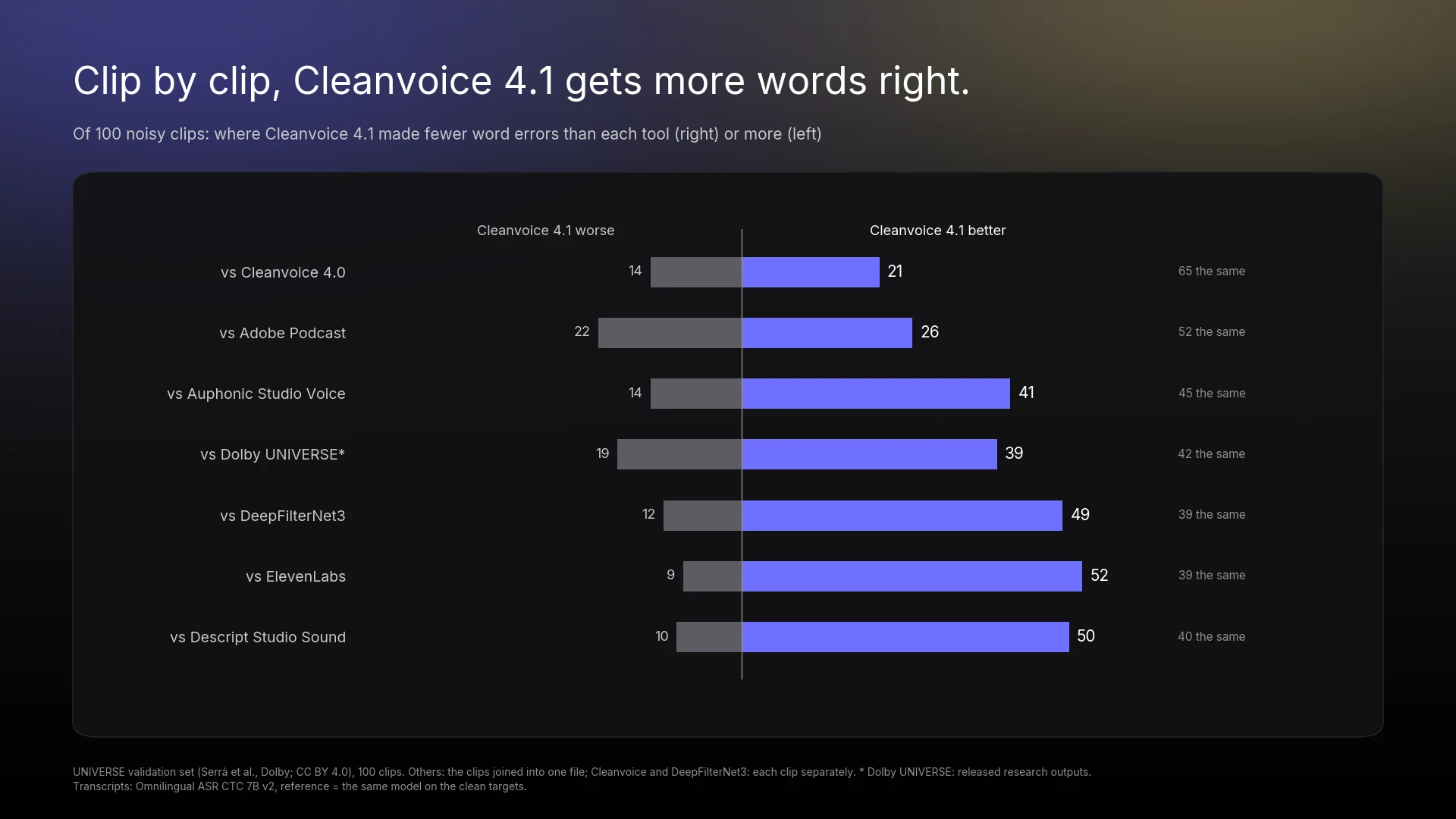
On each of the 100 clips, who made fewer word errors?
| Cleanvoice vs. | Cleanvoice fewer errors | Same | Cleanvoice more errors | WER gap (points) |
|---|---|---|---|---|
| Studio Sound 4.0 | 21 clips | 65 | 14 | +1.2 |
| Adobe Podcast | 26 clips | 52 | 22 | +1.6 |
| Auphonic | 41 clips | 45 | 14 | +4.8 |
| Dolby UNIVERSE | 39 clips | 42 | 19 | +6.8 |
| DeepFilterNet3 | 49 clips | 39 | 12 | +7.1 |
| ElevenLabs | 52 clips | 39 | 9 | +8.3 |
| Descript | 50 clips | 40 | 10 | +9.9 |
WER gap: the other tool's word error rate minus Cleanvoice's.
04Words and sound
Word errors on one axis, overall sound quality on the other.
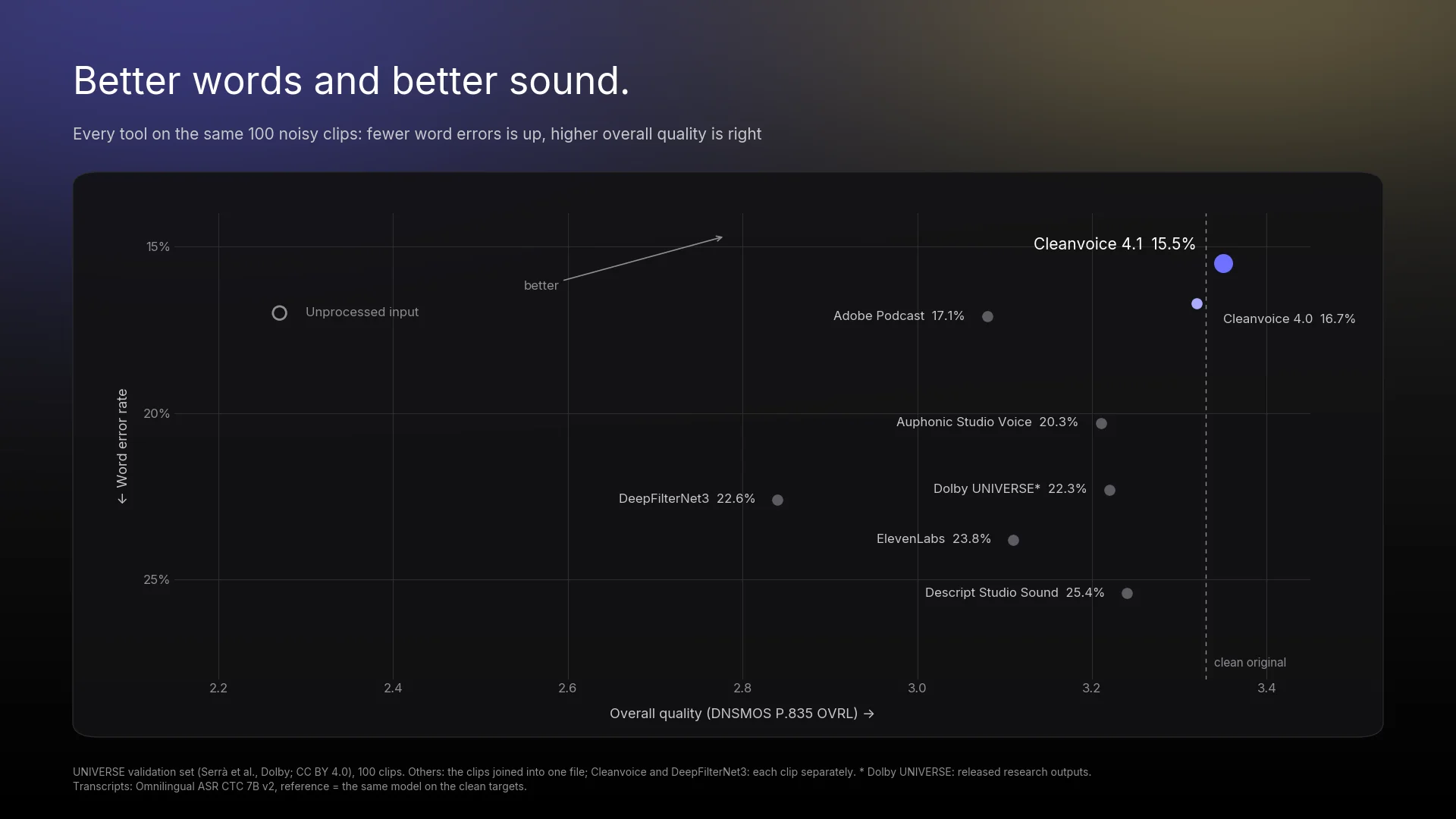
Every tool scored well above the raw input on overall quality (DNSMOS 2.27). Cleanvoice was the only one that also clearly cut word errors: 15.5%, against 17.0% for the raw input. Adobe Podcast stayed level at 17.1%, and the rest made more errors than the raw input.
05Studio Sound 4 vs. 4.1
Five recordings, each with a different problem, through the old model and the new one. These are for listening and aren't part of the score.
8%
fewer word errors than Studio Sound 4
On the same 100 clips, word errors went from 16.7% with Studio Sound 4 to 15.5% with 4.1. Both models processed each clip on its own.
Restoration
Old, damaged audio from a 1960s film.
Selected: Original
0:00Reverb
A voice with room echo.
Selected: Original
0:00Distortion
Distorted speech.
Selected: Original
0:00Thin
A thin-sounding voice.
Selected: Original
0:00Muffled
A muffled voice.
Selected: Original
0:00
06How we tested
- Dataset
- The 100-clip validation set from Dolby's UNIVERSE paper (Serrà et al., CC BY 4.0): noisy, echoey 16 kHz speech with clean originals to compare against. Some of the noise comes from DEMAND (CC BY-SA 3.0).
- Settings
- Each tool's main speech enhancement mode at default strength, with anything that removes silence or trims the file turned off. For Auphonic that's Studio Voice (Beta), its speech enhancement model, and not Speech Isolation, which is a noise remover. Dolby's row uses the outputs published with its paper.
- Word errors
- We transcribed every output and every clean original with Omnilingual ASR CTC 7B v2 from Meta, a multilingual model. CTC models generally don't hallucinate the way models with a language model do, which makes the comparison fairer and more predictable. Errors are per 100 words of the clean transcript (1,423 words in total).
- Sound quality
- SCOREQ and DNSMOS P.835 rate the sound without a reference. ESTOI and PESQ compare it with the clean original. Speaker similarity compares speaker embeddings of the output and the original. All at 16 kHz.
- Bandwidth
- The median highest frequency each tool's output reaches. The input is 16 kHz audio, so it stops at 8 kHz.
- Reruns
- Want the files and scripts to rerun this, or want a tool added? Email support@cleanvoice.ai.
07Limitations
One dataset, 100 clips.
UNIVERSE is built mostly from VCTK speech, all in English. Podcasts, phone calls, music beds and other languages could give different results.
16 kHz input only.
We didn't test full-band recordings here, and the ranking could change on them.
Default settings, one day.
Tools ran on 1 November 2026. Products change, and other settings could give other results.
Test it on your own recordings.
Run your audio through Cleanvoice Studio Sound 4.1 and compare. New accounts get 30 free minutes, no credit card.
Try Cleanvoice